

What affects the cost of clear aligners for adults? An orthodontic expert explains it in plain language: you’re paying for a supervised treatment plan, not a box of plastic trays. Dr. Steven Knapp breaks down what the fee covers, what pushes it up or down, and how to compare quotes honestly.
What Are Clear Aligners, and What Does the Price Actually Cover?
Clear aligners are custom-made, removable plastic trays that move teeth in small, planned steps. An orthodontic expert designs the sequence of movements, and you switch to a fresh tray on a set schedule until your teeth reach their planned positions. A complete clear aligner fee usually covers your records and 3D scan, the doctor’s digital treatment plan, every aligner tray, all progress visits, refinement trays at the finish, and your retainers. The price buys supervision and results, not just plastic.
That distinction matters. Doctor-directed aligners aren’t a one-size product. Dr. Knapp, an orthodontic expert and a member of the American Association of Orthodontists , designs the sequence of movements, decides where tooth-colored attachments go, and plans any interproximal reduction (tiny amounts of enamel polishing between teeth) needed to create space. Those details are what make aligner movement predictable instead of hopeful.
Here’s what a complete adult aligner fee typically bundles:
- Exam, x-rays, photos and a digital 3D scan
- The doctor-designed movement plan and aligner sequencing
- Every tray in your series
- Attachment placement and adjustments
- Progress visits, in person or virtually
- Refinement trays to fine-tune the finish
- Retainers to hold your new smile in place
Quoted fees for adults vary quite a bit from case to case, depending on how much movement your case requires and what’s included. A quote that looks lower than everyone else’s usually leaves something out, so ask what happens if you need extra trays or a replacement retainer.
Retainers are the line item most people forget to ask about. Some offices build them into the treatment price, while others bill for them separately once your trays are finished. Ask about it early and you won’t get a surprise invoice at the end of treatment.
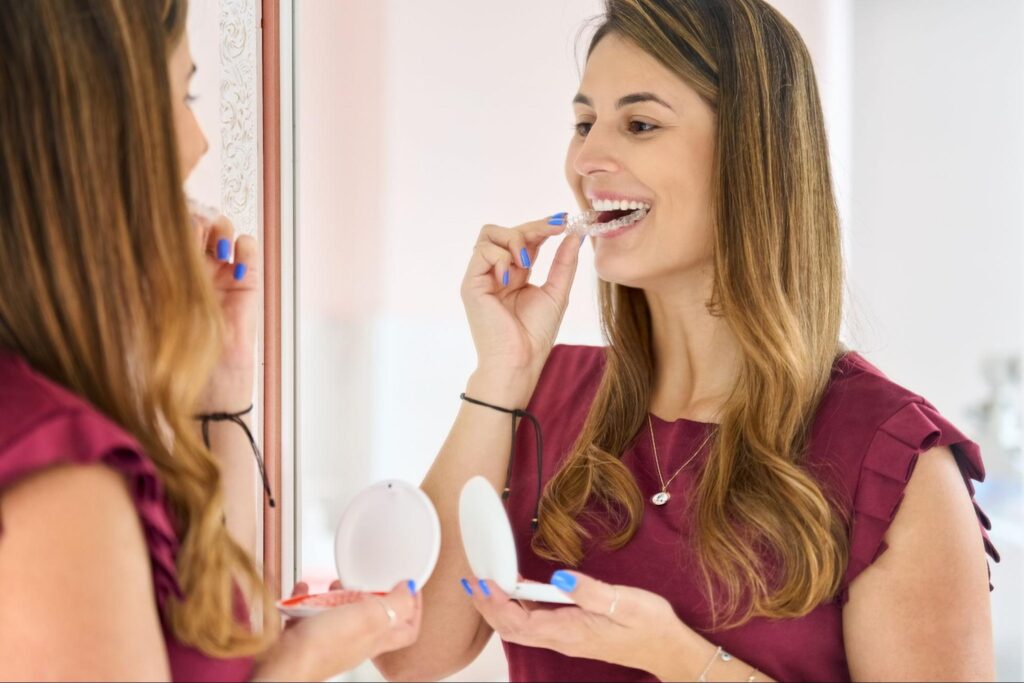
How Clear Aligner Treatment Works From Consultation to Retainer
Every step in aligner treatment adds either chair time or lab cost, which is exactly why plan length shows up in your price. Here’s the process from start to finish.
Step 1: Your free consult and records.
Dr. Knapp examines your teeth, bite and gum health, then takes a digital scan and imaging. This visit confirms whether aligners can do what you want them to do. No strings attached, and no pressure to start that day.
Step 2: The digital plan.
Your orthodontic expert maps each tooth movement in sequence and decides how many trays the case needs. You’ll see a preview of the projected result before anything is ordered.
Step 3: Delivery and daily wear.
Attachments are bonded to specific teeth, and you’ll wear your aligners 20 to 22 hours per day, taking them out only to eat, drink anything other than water, and brush. Trays are changed on the schedule Dr. Knapp sets.
Step 4: Progress checks.
You’ll come in periodically so we can confirm teeth are tracking with the plan. Some checks can be handled virtually, which is a nice perk for adults with packed calendars.
Step 5: Refinements and retention.
Most adult cases finish with a short round of refinement trays to polish the details. Then retainers hold everything where it belongs.
One honest note about retention: teeth remember where they started, and they’ll drift back if nothing holds them. A retainer is the only thing that keeps your result stable long term.
Why Adults Choose Clear Aligners
Adults choose clear aligners because they’re nearly invisible, removable for meals and brushing, planned digitally so you see the projected result up front, and scheduled around real-life calendars. Those four benefits cover most of what we hear at the consult table.
Adults pick aligners for reasons that go well past looks, though looks are definitely part of it.
- They’re subtle. Aligners are nearly invisible across a conference table or on a video call.
- They come out. Eat what you want. Brush and floss normally, which makes hygiene simpler than working around brackets.
- Fewer surprise repairs. No brackets or wires means no poking wire visits, so mid-treatment hiccups are rare. When something does come up, it’s usually a quick fix rather than a costly one.
- You see the plan first. Digital planning shows the projected outcome before you commit a dollar.
- Better long-term function. Straighter teeth spread bite forces more evenly and eliminate tight, hard-to-clean overlaps that trap plaque.
- Predictable scheduling. Visits are spaced out, and some can happen remotely.
We hear the same thing constantly from adults: I should have done this years ago. Dr. Knapp gets it. He got braces himself at age 30. After putting everyone else first, it’s fair to finally focus on YOU. We’re in our treat yourself era.
Clear Aligners vs. Braces vs. Mail-Order Aligners: Cost and Value
Clear aligners for adults generally cost about the same as or slightly more than metal braces, while mail-order aligners advertise lower prices by skipping x-rays, an in-person exam and doctor supervision. Metal braces handle complex movements efficiently at a lower fee. Clear braces cost more than metal but stay fixed and discreet.
| Option | Typical Cost | Treatment Time | Visibility | Supervision | Case Complexity |
|---|---|---|---|---|---|
| Clear aligners | Mid to high range | Often 12-24 months | Nearly invisible | In-office, doctor-directed | Mild to moderate, many complex cases with attachments and elastics |
| Metal braces | Often the lowest of the three doctor-supervised options | Often 12-24 months | Visible | In-office, doctor-directed | All levels, including severe bite correction |
| Clear braces | Higher than metal | Similar to metal | Blends with tooth color | In-office, doctor-directed | Most cases, front teeth especially |
| Mail-order aligners | Lowest advertised price | Marketed as shorter | Nearly invisible | Little to none, remote only | Very limited, minor front-tooth alignment |
The mail-order math looks appealing until you read the fine print. Without x-rays, nobody knows the condition of your roots or bone. Without an in-person exam, active gum disease or a failing crown can go unnoticed while teeth are being pushed. Unsupervised movement carries real risk of root resorption, an opened bite, or a result that has to be redone properly later. Retreatment costs more than treating it right the first time.
When you compare quotes, compare what’s covered:
- Are refinement trays included, or billed separately?
- Are retainers included?
- What happens if a tray is lost?
- Is there a revision policy if teeth don’t track as planned?
- Who is actually reviewing your progress, and how often?
Every plan at Knapp Orthodontics is directed by Dr. Steven Knapp, who holds memberships in the American Dental Association and the Southern Association of Orthodontists , so the recommendation you get comes from your records rather than a script. We prioritize people over profits, so we’d rather tell you braces are the smarter buy for your case than sell you aligners that can’t deliver.
9 Factors That Affect the Cost of Clear Aligners for Adults
The cost of clear aligners for adults comes down to nine things: case complexity, treatment length, number of trays, aligner brand and lab fees, added procedures, refinements, replacement trays, retainers and records, and how you pay (insurance benefits, FSA/HSA dollars, or in-office financing). More movement and more months mean a higher fee.
| Cost Factor | Why It Moves the Price |
|---|---|
| 1. Case complexity | Crowding, spacing, rotations, bite correction and relapse after old braces all require more planned movement |
| 2. Treatment length | Longer plans mean more visits and more chair time |
| 3. Number of trays | Tray count scales with the amount of movement, often 20 to 80 aligners |
| 4. Aligner brand and lab fees | Spark, Angel and other systems each carry their own lab cost, and trays made in our own office can be a lighter lift for smaller cases |
| 5. Added procedures | Attachments, enamel polishing between teeth, elastics and small anchor devices each add chair time |
| 6. Refinements | Extra trays at the finish are standard in many cases and should be quoted up front |
| 7. Replacement trays | Lost trays or inconsistent wear can require re-scanning and reordering |
| 8. Records, imaging and extractions | X-rays, scans and any needed extractions factor into the total |
| 9. Payment structure | Orthodontic lifetime maximums, FSA/HSA funds and monthly payment plans change what you actually pay out of pocket |
Which Factors Move the Price the Most?
Complexity drives everything else. A little front-tooth crowding is a short plan. Correcting a deep bite, closing old extraction spaces, or fixing severe rotations takes more trays, more attachments and often elastics. That’s more of Dr. Knapp’s time, and time is the honest core of any orthodontic fee.
Wear time is a cost factor you control. Aligners only work while they’re in your mouth. Patients who hit 20 to 22 hours a day tend to track on schedule. Skipped wear leads to off-track teeth, extra scans and a longer plan, and longer plans cost more.

How Can You Lower What You Actually Pay?
How you pay changes the number that matters. Two people can have the same treatment fee and very different out-of-pocket costs based on insurance benefits, pre-tax dollars and payment terms. We’re transparent about pricing at the free consult so you know the real number before you decide.
Three levers do most of the work here. An orthodontic benefit with a lifetime maximum knocks a fixed amount off the total. FSA and HSA dollars let you pay with pre-tax income, which quietly shrinks the real cost. And spreading the balance across monthly payments changes how the fee feels month to month, even though the total stays the same. Stack all three and the number on the estimate looks a lot friendlier than it did at first glance.
Our promise stays the same: the smile you deserve at a price you can afford.
Are You a Good Candidate for Clear Aligners as an Adult?
Most adults with mild to moderate alignment concerns are candidates, but records tell the real story. Dr. Steven Knapp, an orthodontic expert and a member of the Alabama Dental Association , reviews your scan, imaging and gum health before anyone quotes you a fee.
You’re likely a good fit if:
- You have mild to moderate crowding, spacing or rotations
- Your teeth shifted after braces years ago (relapse is extremely common)
- Your gums and bone support are healthy
- Your restorations, fillings and crowns are in good shape
- You’ll commit to 20 to 22 hours of daily wear
Braces may be the better recommendation if:
- Your bite discrepancy is severe
- Teeth need significant rotation or vertical movement
- You’d rather not manage removable trays every single day
Braces work 24/7 because you can’t take them off. For some adults, that’s the more realistic route, and there’s no shame in it. Your smile has options.
A few things need attention first. Active gum disease, untreated decay or a failing restoration should be handled before teeth start moving. Certain skeletal cases (where the jaws themselves are mismatched) may need surgical orthodontics for a result that holds.
There’s only one way to confirm candidacy and get firm pricing: an exam with records. That’s exactly what a free consult is for, and there are no strings attached.
Smiles are kinda our thing. Dr. Steven Knapp is an orthodontic expert who holds memberships in the major national and state orthodontic and dental associations . He’s also an adult who wore braces at 30, so he understands the hesitation better than most. Our offices welcome adults, teens and kids, and we have a Spanish-speaking translator on-site. Everybody’s welcome, and our office has immaculate vibes. Ready to see real numbers for your case? Book a free consult and start your smile journey today.

Frequently Asked Questions About Clear Aligner Costs
How much do clear aligners cost for adults on average?
Adult clear aligner fees commonly fall in a broad range depending on case complexity, treatment length and what’s bundled into the quote. A short case with minor crowding sits at the low end, while full bite correction sits higher. The only way to get an accurate number is an exam with records, which we provide free.
Does dental insurance cover clear aligners for adults?
Many dental plans include an orthodontic benefit with a lifetime maximum that applies to aligners the same way it applies to braces, though some plans limit coverage to dependents under a certain age. Benefit amounts and age cutoffs differ from one employer plan to the next. Bring your insurance details to your free consult and our team will help you figure out what applies.
Can I use an FSA or HSA to pay for clear aligners?
Yes. Orthodontic treatment is generally a qualified medical expense, so FSA and HSA dollars can typically be applied to clear aligners. Using pre-tax funds lowers your real cost. Check your plan administrator’s rules on timing, since FSA funds often expire at year end.
Do clear aligners cost more than braces?
Usually a little, yes. Metal braces are often the lowest-fee option because there are no lab-manufactured trays involved. Clear braces land in between. The right comparison isn’t just the sticker number though, it’s which option can actually finish your case well.
How much are clear aligners per month with financing?
Your monthly amount depends on the total fee, your down payment, any insurance benefit, and how many months the plan is spread across. Many adults find in-office monthly payments fit their budget more comfortably than they expected. Ask us to run the numbers at your visit, no commitment required.
Do I have to pay extra for refinements or retainers?
Retainers are folded into your treatment price here, so there’s no separate bill waiting once your trays are finished. Refinement trays are planned as part of finishing most cases, and we tell you up front what’s covered so nothing catches you off guard later. If a retainer wears out or goes missing down the road, call us and we’ll sort it out.